

Harvesting the Arc
 Sanaz Sheybani
Sales Executive







Leveraging Leach’s 270 VDC Hybrid Contactor
Aircraft power systems are becoming more complex and sophisticated. Modern power management relies on higher voltage to meet the higher power demands while meeting a specific weight target.
The 270 VDC power quality, first defined in MIL-STD-704B in 1975, was an important step forward in aerospace. These systems now power modern military aircraft, offering increased power density which is required for specific subsystems and components, flight control systems, and electric actuators.
With the industry’s transition to More Electric Aircraft (MEA), there is a growing demand for managing the increased complexities involved in “hot-switching” of 270 VDC systems. High-voltage power switching presents serious engineering challenges for make and break operations for traditional electromechanical contactors. Engineers must solve multiple problems at once with the constraint of size and weight for aerospace applications. These problems range from managing inrush current and arc suppression, to maintaining the electrical life cycles required for reliable operation.
The hot-switching challenge
Power management in modern aircraft presents specific challenges across different applications. Generator line contactors, main line contactors, battery contactors, and crosstie contactors all face the same critical issue: reliable hot switching at high voltages.
Hot switching presents two challenges:
- Inrush Current: When closing the circuit – particularly with 270 VDC systems – the inrush current into capacitive loads can reach levels ten times higher than in 28 VDC systems. Many traditional high-voltage contactors either can’t handle these current levels or fail to meet normal operational cycle requirements. When they fail, they often weld closed and can’t reopen, forcing system designers to add pre-charge devices to reduce inrush current.
- Overload: The second challenge comes during break operations. Most available high voltage contactors show a significant reduction in electrical life cycles at overload currents above 200 A, creating potential safety issues during fault conditions or short circuits. This limitation is particularly dangerous when the contactor needs to open under fault conditions.
Leach’s hybrid contactor handles both challenges. It manages extreme inrush currents during circuit closing while maintaining reliable operation. During breaking operations, its performance far exceeds conventional contactors, enabling safe operation in both normal and fault conditions.
What is the solution?
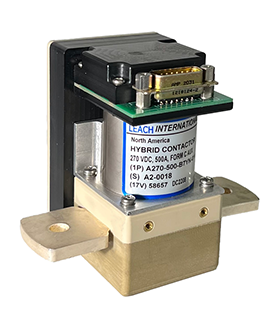
Leach’s 270 VDC hybrid contactor is an enabling technology providing an elegant solution for hot switching at full-rated power. It sets new benchmarks in safety and reliability for 270 VDC electrical power systems. As the mechanical contacts begin to separate, the resulting electrical arc powers the arc suppression’s control electronics. This self-powering approach eliminates the need for external power supplies while enabling precise control over the switching sequence and maintaining galvanic isolation. A semiconductor switch then takes over to extinguish the arc, protecting the contacts while maintaining optimal performance.
The hybrid contactor features superior contact material which allows a 4,000 Amp rupture capacity and the ability to handle 1,000 A overload for 10,000 make and break cycles. Most notably, it achieves over 50,000 cycles at 270 VDC and 500 A – far exceeding the typical cycle limit of conventional contactors in this class. Available in 200 A, 400 A, and 500 A options, it delivers excellent electrical performance with a typical voltage drop of just 50 mV for the 400 A options.
The contactor is designed in accordance with MIL-PRF-6106P, MIL-STD-810F and RTCA/DO-160G standards for handling extreme environments with ease. It is designed to offer efficient thermal management without external cooling, yet weighs just 2.1 pounds, making it ideal for aerospace and defense lightweight applications where performance and reliability cannot be compromised.
The contactor excels in two critical applications: as a main line contactor in front of power sources like generators and batteries, and in primary power distribution switchgear for electrical power systems. In both roles, its robust design and high cycle life contribute to a high MTBF, allowing significantly reduced maintenance schedules.
Looking forward
The aerospace industry continues its shift toward 270 VDC electrical power systems, particularly in military aircraft. Leach’s hybrid contactor technology, developed to support U.S. Air Force Research Laboratory (AFRL) programs, plays a key role in enabling these advanced power architectures. The technology’s maturity is demonstrated by its use in sixth-generation aircraft development, where other 270 VDC switchgears have achieved Technology Readiness Level 8 and 9 – the highest level of operational maturity. As both new aircraft designs and platform upgrades increasingly adopt 270 VDC systems, reliable hot-switching solutions become crucial. The hybrid contactor’s proven ability to manage high inrush currents and fault conditions makes it essential for next-generation power management for both military and commercial aircraft.

Sanaz Sheybani
Sales Executive
Sanaz Sheybani leads technical sales and business development for aerospace and defense electrical power distribution systems across the United States and Canada. At Leach International, she partners with OEMs and engineering teams to support the development and integration of advanced power architectures – including PDUs, SSPCs, relays, and contactors – enabling next-generation, higher-voltage aircraft platforms.